
DLSS 5 in Lineage II High Five: What It Changes and What We Are Testing
A source-linked guide to DLSS 5, the Lineage2AI High Five visual experiment, and the evidence still required before calling it a verified native integration.
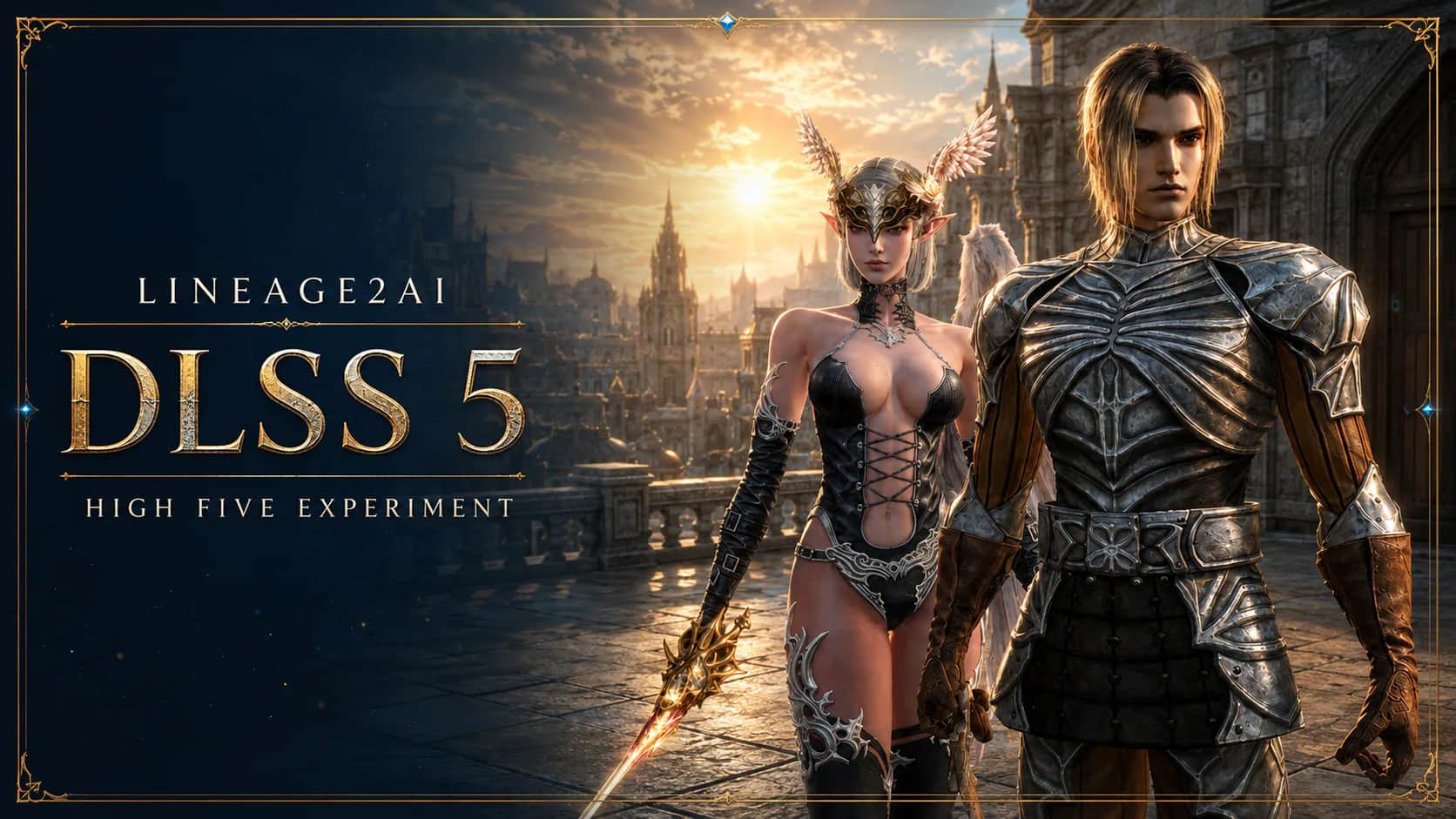 Original editorial visual · Lineage2AI
Drag to compare the High Five experiment
Move the divider left or right to reveal more of either supplied frame.
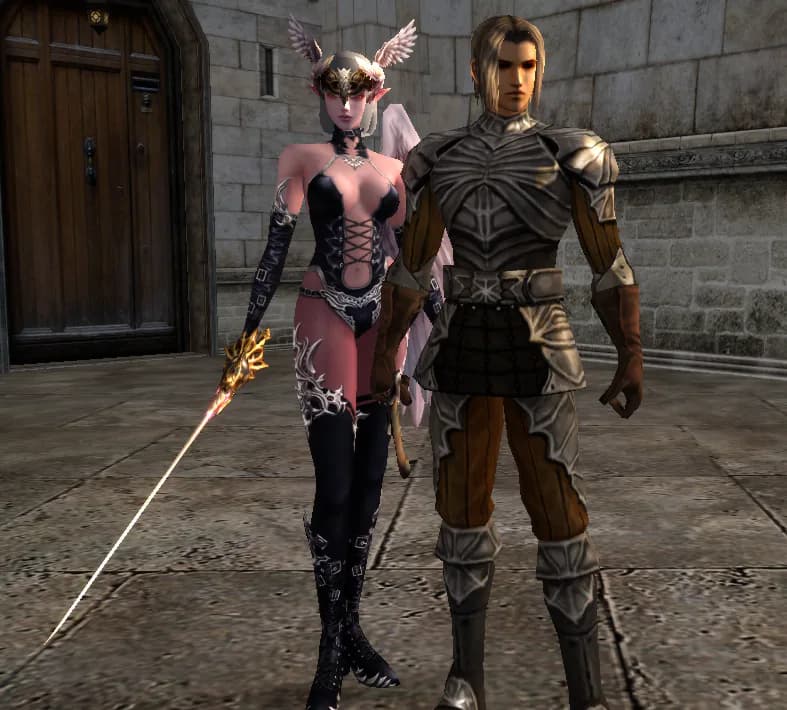 DLSS 5 OFFDLSS 5 ON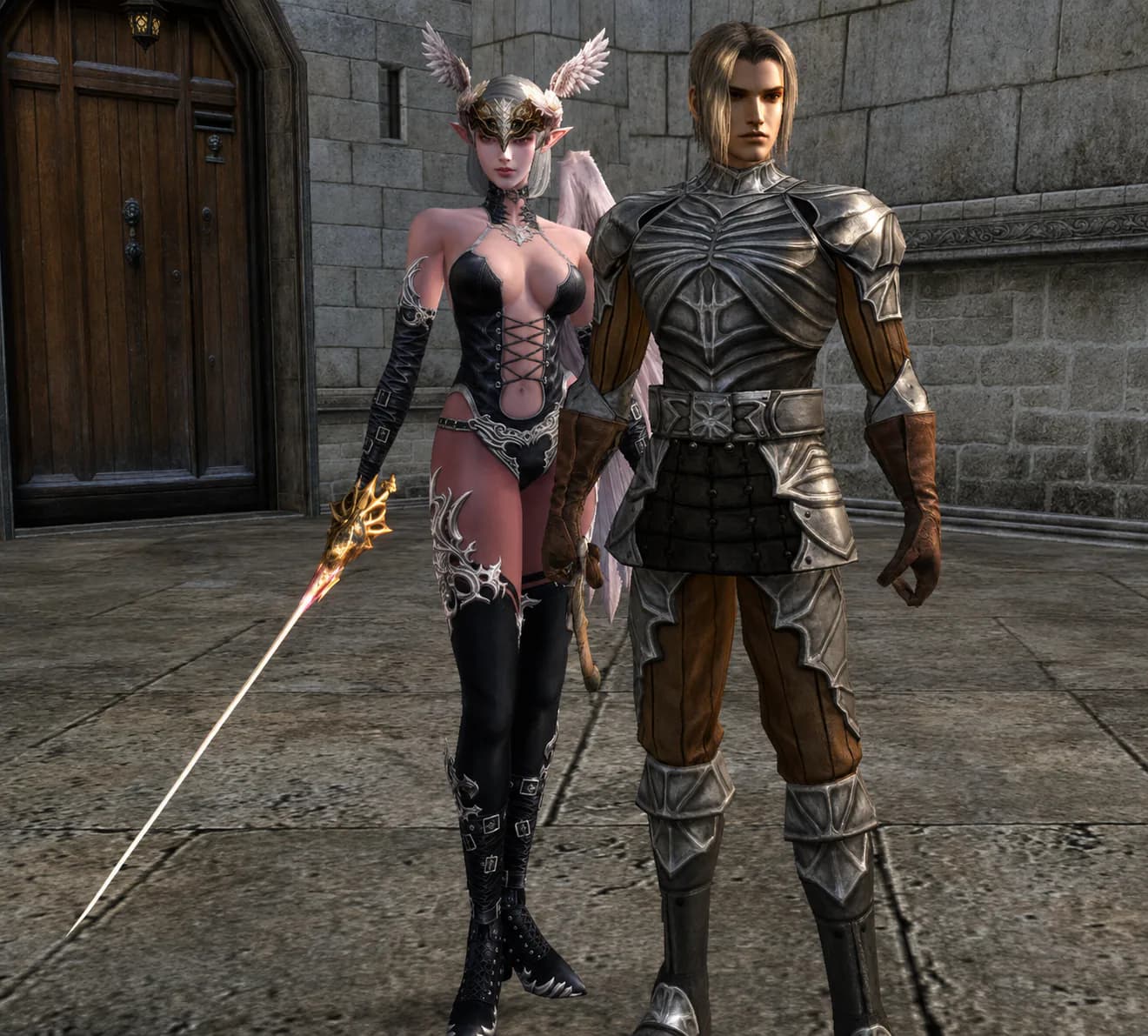
DLSS 5 is not simply a sharper version of ordinary upscaling. It is NVIDIA’s new 3D-guided generative neural-rendering stage: the game still renders the world, but an AI model uses that frame and engine guidance to produce the final displayed appearance with richer lighting and material response. NVIDIA made the technology available on September 1, 2026, beginning with NBA 2K27 on GeForce RTX 50 Series hardware.
Lineage2AI is exploring what that idea could mean for the Lineage II High Five client. The interactive images on this page show the visual direction we are investigating: denser armor detail, more natural light across skin and metal, and an old Aden scene that feels less flat without losing its identity.
There is an important evidence boundary. The supplied OFF and ON images are a visual target study, not yet proof of a native, real-time DLSS 5 integration. Our September 6 audit of the canonical client found the legacy d3ddrv.dll renderer and no NVIDIA DLSS, NGX or Streamline runtime module by filename. We will not call the High Five integration complete until an exact build, signed runtime inventory, live toggle capture and repeatable performance record all agree.
What DLSS 5 actually is
Earlier DLSS generations became known for reconstructing a higher-resolution image from a lower-resolution render, adding generated frames and cleaning ray-traced lighting. DLSS 5 adds a different kind of capability. NVIDIA describes it as the final stage of the graphics pipeline: a compact generative model enriches the appearance of the frame while the original engine frame remains the structural foundation.
According to the NVIDIA ADLR research description, the model is a one-step pixel-space diffusion system conditioned on the current rendered frame, engine motion vectors, temporal state and artistic-direction values. Training also uses renderer-derived scene attributes to keep the generated appearance grounded in the authored scene. NVIDIA says the result is causal, deterministic and trained for frame-to-frame stability rather than behaving like a general image generator that invents a different answer each time.
This distinction matters. DLSS 5 is not supposed to redesign a character, move a wall or replace the level designer. It is intended to improve difficult visual phenomena that real-time engines simplify: light passing through skin, hair or foliage; subtle contact shadows; ambient occlusion; reflective and layered materials; and the way broad lighting changes the tone of a scene.
NVIDIA calls the method 3D-Guided Neural Rendering. In plain language, the 3D game remains the anchor, and the neural model adds appearance knowledge on top.
DLSS 5 versus DLSS 4.5
The version number can make the change sound incremental, but the jobs are different.
| Technology | Main job | What the AI produces |
|---|---|---|
| DLSS Super Resolution | Reconstruct a higher-resolution frame | More output pixels from a lower render resolution |
| DLAA | Improve anti-aliasing at native resolution | Cleaner edge and temporal reconstruction |
| Frame Generation and Multi Frame Generation | Increase displayed frame rate | Additional frames between conventionally rendered frames |
| Ray Reconstruction | Replace hand-tuned denoisers | Cleaner ray-traced lighting information |
| DLSS 5 Neural Rendering | Enrich final visual appearance | Lighting and material detail grounded in the engine frame |
NVIDIA says the complete DLSS 4.5 suite can generate or reconstruct 23 of every 24 displayed pixels. DLSS 5 does not replace those tools. It is an optional, independent stage that can run alongside Super Resolution, Multi Frame Generation and Ray Reconstruction. That means “DLSS 5 on” is not automatically a promise of a particular frame-rate increase; image appearance and performance technologies still need to be measured separately.
What a player may notice
The easiest place to see the difference is not a distant mountain. It is a familiar face, a polished chest plate or a character standing between a bright sky and a dark doorway.
In NVIDIA’s first shipping example, NBA 2K27, the company points to light scattering through ears, more natural skin under arena lighting, improved hair response, deeper contact shadows and clearer folds in clothing. Those are appearance changes that can make a scene feel more physically coherent even when the underlying model and animation are unchanged.
For Lineage II, the interesting possibilities are easy to imagine:
- a Dark Elf’s skin and silver ornamentation responding differently to torchlight;
- engraved armor catching highlights without turning into a uniformly shiny surface;
- hair, feathers and translucent spell effects holding more believable light at their edges;
- stone streets gaining clearer contact and depth cues at sunrise;
- indoor halls and outdoor hunting zones keeping distinct material moods.
None of this automatically gives High Five new geometry, better animation, redesigned textures or modern world assets. NVIDIA explicitly notes that the final quality depends on the quality of the base frame and guidance data. A stronger source render gives the neural stage better information to work with.
The Lineage2AI High Five visual experiment
The comparison supplied for this article expresses a target: keep the scene and characters recognizable while making material response, local contrast and fine detail feel closer to a modern presentation. Drag the divider to study both frames rather than relying on two distant thumbnails.
The pair is useful for art direction, but not yet for a scientific performance or integration claim. The OFF image is 787 by 710 pixels; the ON image is 1320 by 1192 pixels. Their proportions are nearly identical, so they align well in an interactive slider, but the files do not carry a versioned capture manifest, GPU/driver record, runtime logs, frame timing or proof that a live DLSS 5 toggle produced both images in the same client session.
That is why this page calls them a visual study. A reader can judge the intended look. A reviewer cannot yet infer native DLSS 5 execution from the look alone.
Why High Five is a difficult integration
The canonical High Five client is a legacy application with a Direct3D-era renderer very different from the modern pipelines shown in NVIDIA’s documentation. Our inspected client contains d3ddrv.dll, and its current public inventory contains no file named as an NVIDIA DLSS, NGX or Streamline runtime.
Current NVIDIA Streamline documentation describes explicit application integration around modern graphics devices, feature support checks, tagged resources and the point in the frame where a feature is evaluated. The public DLSS 5 launch material names Streamline and an Unreal Engine 5 plugin as integration paths. It does not announce a ready-made Unreal Engine 2 or Lineage II High Five plugin.
The harder problem is not copying a DLL beside L2.exe. DLSS 5 needs trustworthy information from the running frame. NVIDIA names color and motion vectors, and its technical explanation also discusses guidance such as albedo, lighting and surface normals. A legacy client may not expose those resources in the expected form or at the correct time. A serious integration must identify how the renderer creates them, how the neural stage receives them, how the user interface is excluded or preserved, and what happens when the feature is unsupported.
An adapter or renderer modernization layer may be possible. That is an engineering hypothesis, not a completed result. It must also respect NVIDIA’s SDK and redistribution terms; this project will not publish unlicensed runtime binaries or present a community injector as official support.
What verified integration would look like
A convincing “DLSS 5 works in High Five” statement needs more than a beautiful still image. Lineage2AI’s release gate requires a compact evidence bundle:
- Exact build identity. Hashes for
L2.exe, the active renderer, the adapter and every NVIDIA runtime module. - Authentic runtime inventory. Signed production libraries, recorded versions and a documented, licensed source.
- Supported execution path. The graphics API, GPU, driver and feature-support result captured from the same run.
- Live same-scene toggle. A continuous video showing one client, one camera position and an OFF/ON switch without restarting into a different build.
- Temporal review. Movement, particles, hair, UI, water, combat and camera turns checked for shimmering, swimming, ghosting or identity drift.
- Performance method. Resolution, preset, frame-time distribution, latency, VRAM use and at least one fallback path recorded—not only a best-case FPS number.
- Compatibility boundary. Which RTX 50 cards, Windows builds, drivers and client modes pass; what non-supported hardware sees; and how the feature can be disabled cleanly.
- Human acceptance. A named IN_GAME scenario reviewed and accepted, followed later by a longer SOAK run.
Only then should a visual comparison be captioned as a native DLSS 5 result. Until then, SOURCE evidence can prove that code or files exist, and a static experiment can show an art target, but neither equals IN_GAME verification.
What Lineage2AI can say today
Lineage2AI is actively experimenting with a DLSS 5 visual direction for High Five and has built the website media path needed to show a clear OFF/ON comparison. The article’s source research, client inventory and image provenance are recorded in the same evidence-gated publishing package.
The project cannot yet responsibly say that DLSS 5 is successfully integrated into the canonical High Five client. The current client audit does not contain the expected NVIDIA runtime footprint, and the supplied images are not bound to a live capture record. This is a solvable verification gap, but it is still a gap.
The goal remains compelling: let players return to Aden and see familiar places with richer light, materials and depth while keeping the world recognizable. Lineage2AI intends to present its first official High Five graphics build soon, after the remaining compatibility and live-client checks pass. Here “official” means an official Lineage2AI project release—not an NVIDIA or NCSOFT edition. If the client path passes the integration and gameplay gates, the feature can move from a visual experiment to an optional graphics mode.
Common questions
Is DLSS 5 already a real product?
Yes. NVIDIA announced it in March 2026 and released it on September 1, 2026. As of this review, NVIDIA identifies NBA 2K27 as the first available game and says the feature runs on GeForce RTX 50 Series GPUs and GeForce NOW.
Does NVIDIA naming NCSOFT as a supporting publisher prove Lineage II support?
No. NVIDIA’s March announcement named NCSOFT among publishers expected to support DLSS 5 and listed AION 2 among planned games. It did not name Lineage II High Five. Corporate participation is not evidence for a specific client build.
Are the images in this article fake?
They are real supplied image files used for a visual-direction study. What is not yet established is their runtime provenance. The article deliberately avoids presenting them as a controlled native DLSS 5 capture.
Will DLSS 5 run on every old Lineage II computer?
No such compatibility claim is supported. NVIDIA’s first release is for GeForce RTX 50 Series GPUs. Any High Five implementation would also need a tested legacy-client adapter, a supported driver and a clean fallback for other hardware.
When can players use it?
Lineage2AI plans to present the experiment officially soon, but has not announced a responsible public download date. The next meaningful milestone is a signed runtime inventory and a same-session IN_GAME OFF/ON capture from the canonical client. When that evidence exists, this article will be updated with the exact build and limitations rather than quietly replacing the experimental record.
Evidence note
This is first-party documentation from the Lineage2AI project. NVIDIA sources establish what DLSS 5 is and where NVIDIA says it is available. Lineage2AI’s local audit establishes only the inspected High Five client inventory and the current evidence gap. It does not establish a native integration, an NVIDIA partnership, an NCSOFT endorsement or public-release readiness.
This evidence boundary follows the Lineage2AI release-evidence ladder: SOURCE, OFFLINE, BOOT, IN_GAME and SOAK are separate claims, and a visual target never skips those gates.
Further reading
Sources and references
- 01
First Party Product PagePrimary
NVIDIA DLSS 5 Available Now: 3D-Guided Neural Rendering Debuts in NBA 2K27NVIDIA GeForce · accessed 2026-09-22 - 02
Research PaperPrimary
DLSS 5: Generative Neural RenderingNVIDIA ADLR · accessed 2026-09-22 - 03
NewsPrimary
NVIDIA DLSS 5 Delivers AI-Powered Breakthrough in Visual Fidelity for GamesNVIDIA GeForce · accessed 2026-09-22 - 04
Official DocumentationPrimary
NVIDIA Streamline Programming GuideNVIDIA-RTX · accessed 2026-09-22
Editorial transparency
A project perspective, clearly marked.
Lineage2AI is our own project. We distinguish first-hand experience, external research, product plans and opinions, and we do not present concepts as shipped gameplay.
Report an error or suggest a correction